
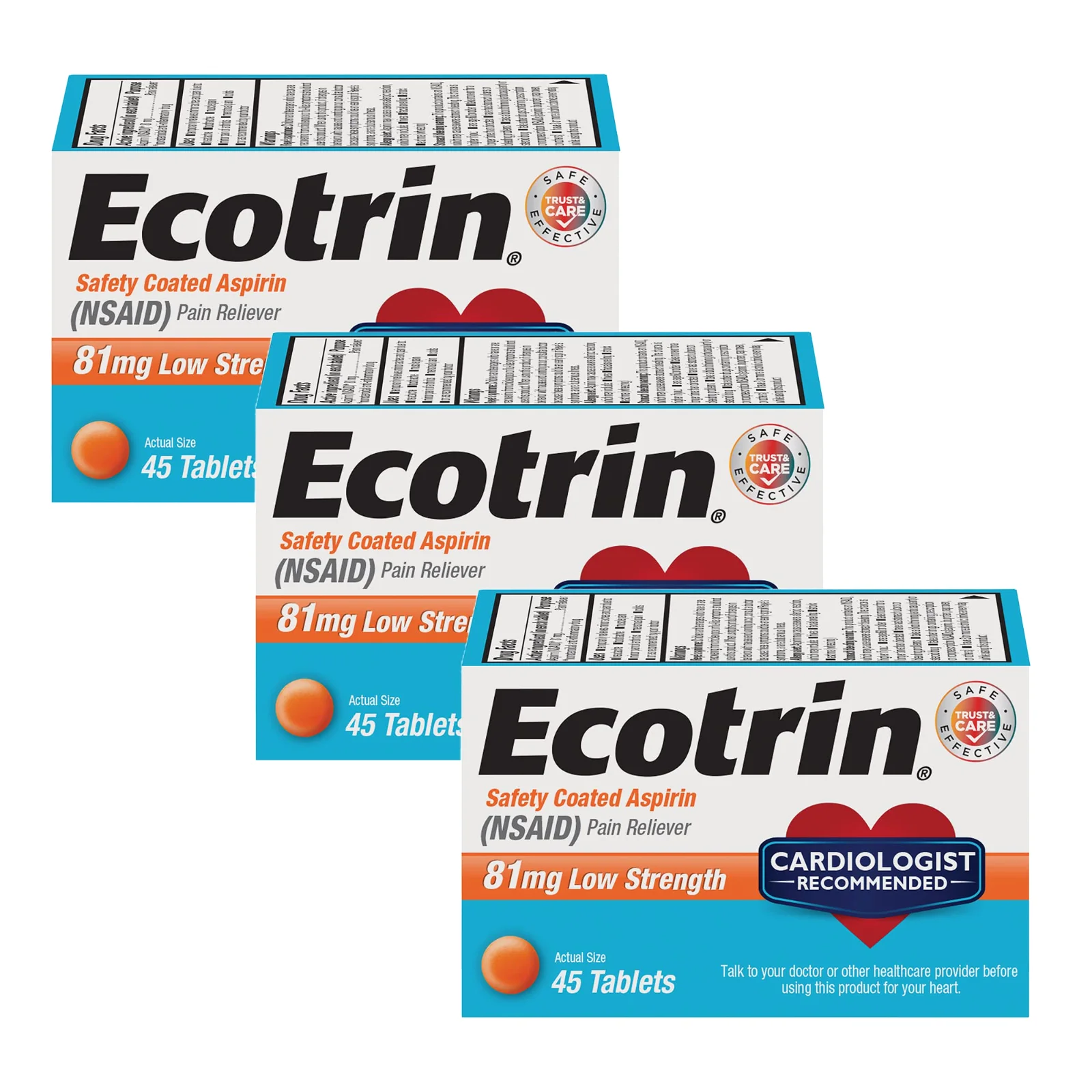
This site is general information about Ecotrin packs and their labels. It is not medical advice, and it is not a substitute for a conversation with a doctor or pharmacist. Do not start, stop or change a daily aspirin regimen without talking to your health care professional, and always use this medicine exactly as the label directs.
Tip an Ecotrin tablet into your palm and the first thing you notice is the finish: a small, smooth, slightly glossy disc, more like a bead than a chalky pill. That finish is not cosmetic. It is the entire idea of the brand, printed right in the name on the carton: safety coated aspirin. The medicine inside is ordinary aspirin, an NSAID that pharmacies have stocked for over a century. The shell around it is the subject here.
We keep this catalogue, and questions about the coat arrive at our desk more than questions about anything else: what it is, whether it can be split, why the label insists on swallowing whole, what happens in a pill organizer, what happens in a hot car. Most of the answers live on the label itself, in the terse register of a Drug Facts panel. What follows unpacks that register into plain language, and stops exactly where the label stops. Anything past that line, whether this medicine belongs in your day at all, is a conversation for your doctor, not for a catalogue.
What the coat is, in the label’s own terms
The label describes the mechanism in one line: the coating is designed to let the tablet pass through the stomach intact and dissolve further along, in the small intestine. Pharmacists call this kind of shell an enteric coating, from the Greek word for intestine. It is engineered to hold its shape in one chemical environment and give way in another, and that engineering is what you feel in the hand: a tablet that reads as decidedly sealed.
It is worth being precise about what that one line does and does not say. It describes where the tablet is meant to dissolve. It does not promise any particular outcome for any particular person, and neither will we. Aspirin itself, whatever its shell, is a serious medicine with real indications and real risks, and the public guidance we read and cite on our routine page is unambiguous that decisions about it belong with a health care professional.
Why the label says to swallow it whole
Every instruction on the panel earns its place, and the one most often ignored is the plainest: swallow the tablets whole, do not crush or chew. The logic is mechanical. A coat can only do its work while it is intact. Crush a coated tablet and you have removed the coat as surely as peeling it. The engineering is gone, and what reaches your stomach is plain uncoated aspirin plus fragments of shell.
This is why the design of the tablet itself matters more than it seems. An 81 mg Ecotrin disc is deliberately small and smooth, sized so that swallowing it whole is the unremarkable option. People who came to a regimen late in life, when large tablets have become genuinely difficult, tend to notice this detail first and mention it most. A tablet that is easy to take whole is a tablet that never tempts anyone toward the kitchen mortar.
If swallowing whole is a real problem in your household, that is not a puzzle to solve with a pill crusher. It is a question for a pharmacist or doctor, who can look at the whole picture and name alternatives. We say this without exception because the alternative advice, however kindly meant, would be exactly the kind of medical improvisation a label exists to prevent.
An old idea, done carefully
A wrap that hides a taste is old pharmacy craft, and it is not what this is. The enteric coat is a shell built to survive one environment and give way in another, engineered around the difference between one part of the digestive tract and the next. It is chemistry doing work that no amount of willpower or water can do.
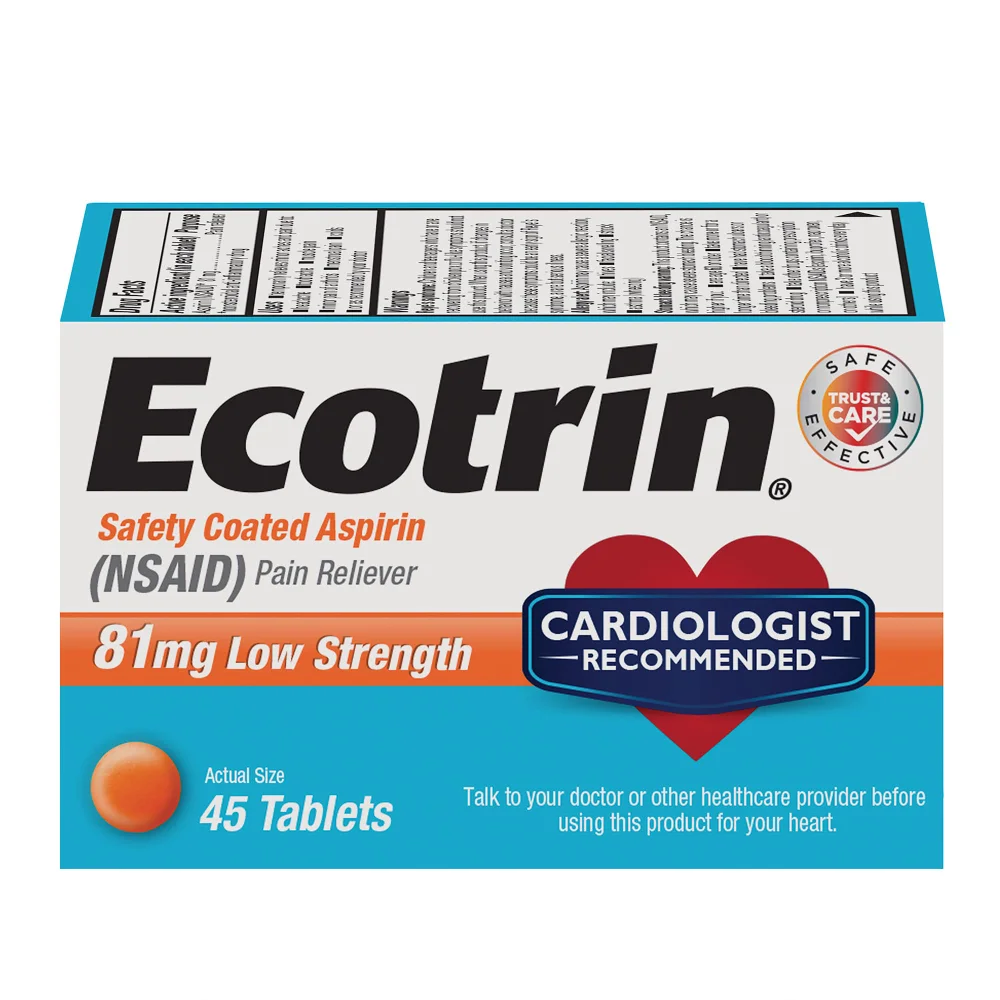
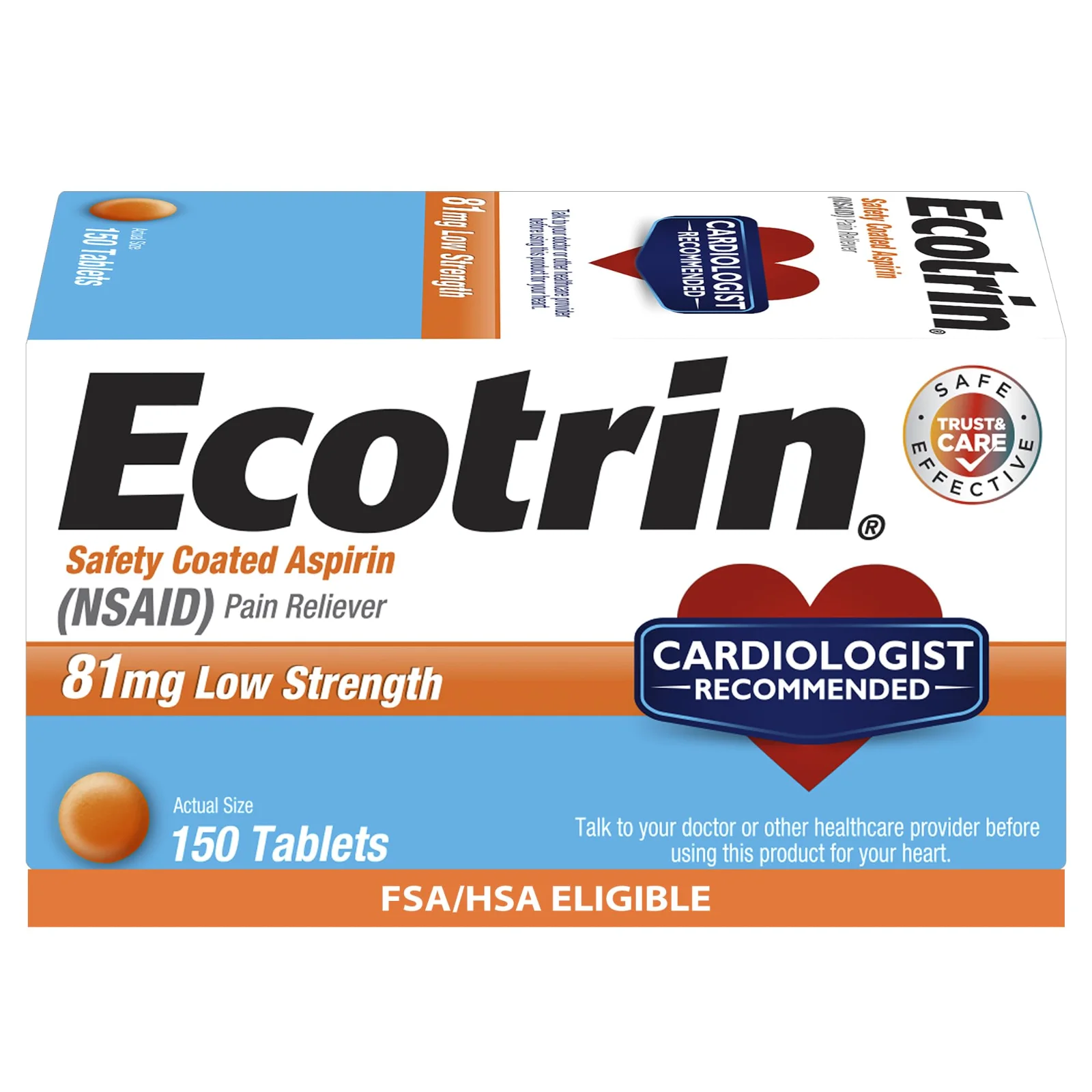
What makes the idea interesting on a catalogue like this one is that the engineering cannot be seen, at the moment of purchase or at the moment of use. Two tablets, one coated and one plain, look nearly identical in a photograph and cost the same attention to swallow. So the carton says it instead: the brand name carries the claim, and the front prints Safety Coated Aspirin on the same face as the strength and the count. When the work is invisible, the label does the telling.
The glance test: reading a tablet in the hand
A household habit worth adopting with any coated medicine: glance at the tablet you are about to take. An intact Ecotrin disc is uniform, smooth and unbroken. That is the design working. A tablet that has cracked in transit, or one you find chipped at the bottom of a bottle that travelled badly, is a tablet whose engineering is compromised, and the honest response is to set it aside rather than shrug it down.
The glance costs half a second and it turns every morning into a small quality check. It is also the habit that catches the rarer problems, a bottle that got wet, a cap that was not seated, before they become a week of doubtful tablets. We photograph every pack on this site the same way we suggest you look at the tablets: plainly, in decent light, expecting nothing but willing to notice.
The same glance settles a question that sometimes worries careful readers: whether anything can be told about a tablet by its colour or sheen fading slightly between bottles. Manufacturing varies within ordinary tolerances, and the honest tellers are the ones above, cracks, chips, moisture damage, a passed expiry date, not shade. When a tablet genuinely looks wrong to you, the pharmacy counter will look at it with you. That is a better use of two minutes than a search box ever is.
The kitchen drawer full of temptations
Every kitchen owns the tools that defeat a coated tablet: the knife that splits, the spoon that crushes, the pill cutter bought years ago for something else. With this range they stay in the drawer, for two stacked reasons. The mechanical one is the coat itself: cut a coated tablet in half and both halves are now uncoated at the cut face, which unwinds the one thing the product is built to do.
The deeper reason is what splitting usually means. A person halving tablets is a person adjusting a dose, and dose belongs to the label and the professional who read it with you, never to a kitchen knife. The range already comes in two strengths precisely so that nobody has to manufacture a third one at the counter. If neither printed strength matches what your doctor named, that mismatch is a pharmacy conversation, and a five-minute one at that.
Handling: what a sealed tablet asks of a household
A coated tablet is robust in the hand. It does not powder at a touch, it survives a rattle in the bottle, and it tolerates the ordinary handling of being counted out. What it asks for is the same thing every tablet asks for, kept a little more seriously: dryness, room temperature, and the original bottle with the lid actually closed.
The bottle deserves a word of its own. The range is sold in real bottles with real caps, from the squat 45 to the tall 365, and the bottle is part of the product. It keeps moisture out, it keeps the label attached to the medicine it describes, and it keeps the count honest, because a bottle that started at a printed number can always be reconciled against the calendar. Decanting tablets loose into a bag or an unlabelled jar surrenders all three: the dryness, the label and the count.
Heat is the quiet enemy. A parked car in summer, a bathroom shelf directly over a radiator, a windowsill in the sun: these are the places tablets get left, and the label’s storage line about controlled room temperature is aimed straight at them. The medicine cabinet the phrase was named for, cool, dark and dry, remains the right answer for the boring reason that it works.
The pill organizer question, answered mechanically
The most practical question we get is about weekly pill organizers: can a coated tablet live in one? We can answer only the mechanical half, and the mechanical half is reassuring. The coat is not so fragile that a week in a clean, dry, closed compartment defeats it. It is built to survive handling. What a household should carry over from the section above is the environment: an organizer parked in a steamy bathroom or a hot car undoes the care that the bottle was providing.
The half we will not answer is whether an organizer fits your particular regimen and your particular set of medicines, because compartments mix medicines, and mixing is exactly where a pharmacist’s eye belongs. Bring the organizer to the counter and ask. It is a two-minute conversation, and it is theirs to have.
Travelling with a coated tablet
Travel is where good storage habits go to die, so the arithmetic deserves stating. For a trip, count the days, add a margin for the delayed flight and the extended stay, and carry that many tablets in the smallest real bottle in the range rather than a sandwich bag. The 45-count bottle earns its place in the catalogue largely on this job: it is a genuine, labelled, capped container that happens to be pocket-sized.
Carrying the labelled bottle is not just tidiness. A labelled container answers questions at security lines, at borders, and in the worst case at a clinic far from home, where a stranger may need to know exactly what you take. A bag of loose orange discs answers nothing.
Why bottles and not blisters
A fair question about the whole range: why real bottles rather than the blister cards so common elsewhere in the aisle? For a regimen medicine, the bottle wins on three mechanical counts. It keeps a printed count that can be audited against a calendar, which the refill arithmetic in the year notes depends on. It reseals properly after every opening, which a torn blister card never does again. And it keeps the full label physically attached to the medicine for the life of the supply, Warnings section and all.
Blisters have their virtues, single-dose hygiene above all, and nothing here argues with them in general. But a household running a year of mornings needs the three things a bottle keeps and a blister card does not: a printed count on the label, a cap that reseals after every opening, and that same label attached for the life of the supply. The bottle is the format that matches how this medicine is actually lived with.
Reading the Drug Facts panel like the label desk does
Every carton in this range carries the same standard panel, in fixed sections and a fixed order, so that any two medicines can be compared line against line. Read it once in that order: the active ingredient and its strength, then the warnings, then the direction to swallow whole, then storage, then the expiry.
| Panel section | What it tells you | How to read it |
|---|---|---|
| Active ingredient | The medicine and the strength per tablet | For these shelves: aspirin, 81 mg or 325 mg. The front of the carton repeats it. |
| Uses | What the medicine is indicated for | The label’s own list, not ours. Nothing on this site extends it. |
| Warnings | Who should not take it, and what to ask a doctor about first | The longest section on purpose. Read it whole, once, slowly. |
| Directions | How it is taken, including swallow whole | The swallow-whole line is the coat speaking. |
| Other information | Storage and handling | The room-temperature line aimed at hot cars and steamy shelves. |
| Inactive ingredients | Everything that is not the medicine, the coat included | Where anyone checking for a specific ingredient should look. |
Two habits make the panel genuinely useful. First, read the Warnings section before the first tablet, not after a question arises: it is the section written for exactly the conversations the heart association urges people to have with their doctor first. Second, when anything on the panel is unclear, take the carton itself to the pharmacy counter. The panel is designed to be read alongside a professional, and pharmacists read them all day.
The shelf out of small reach
One line of the Drug Facts panel deserves its own paragraph in any household with children: the Warnings section speaks to children and teenagers directly, and it is not a section to summarize secondhand. Read it on the carton, whole, and let it say what it says. Our part of the subject is the storage half, and it is unambiguous: aspirin is an adult medicine on these shelves, and the bottle belongs where small hands do not reach, capped, high and out of sight.
The 365-count bottle sharpens the point simply by being large and long-lived: a bottle that stands in the same spot for a year becomes furniture, and furniture stops being noticed. Households with visiting grandchildren know the drill better than anyone, and the cheap insurance is the same as ever: the high shelf, the closed cap, and the habit of putting the bottle back rather than leaving it out between mornings.
Three questions that keep arriving at the label desk
Can a coated tablet be taken with food or without? The label’s Directions section is the authority on how the tablets are taken, and anything it leaves open is a fine question for a pharmacist. Our desk reads labels, not patients.
Does the coat change how quickly the medicine works? The coat changes where the tablet is designed to dissolve, and that is as far as a catalogue can honestly go. What that means for any particular purpose in any particular person is a professional’s question, and a good one to bring to the conversation described in the doctor notes.
Do the coated tablets expire differently? Every bottle carries its own expiry date printed by the maker, and that date outranks anything a website could say. The habit worth keeping is to glance at the date when a bottle is opened, and again if a bottle has sat unopened for a long stretch. A pharmacy can advise on disposal of anything that has aged out.
What the coat does not change
It is easy, standing in an aisle, to let a coat imply more than it says. So, plainly: the coating does not change what the medicine is. Inside the shell is aspirin at the strength printed on the front, with everything the Warnings section says about aspirin fully in force. The coat does not make the tablet suitable for anyone the label excludes, does not alter who should ask a doctor first, and does not move any decision out of the consulting room.
What it changes is engineering: where the tablet is designed to dissolve, and what the label therefore asks about swallowing it whole. That is the honest boundary of the idea, and the brand has held that boundary in its name for as long as the shelves here have carried it.
Where this leaves a careful household
Treat the tablet as the sealed object it is: whole, dry, capped, cool, in its own labelled bottle, counted against the calendar. Bring the label to the professionals who are paid to read it with you, and bring them the organizer too. The refill arithmetic that keeps a year-long bottle from running dry has its own working notes, and the questions worth carrying into the consulting room are laid out in the doctor conversation notes. The shelves of Ecotrin safety coated aspirin hold the packs themselves, each with its strength and count at the head of the card.
A last word on why a catalogue bothers writing any of this down. Most of what goes wrong between a well-made tablet and a well-run household is handling rather than chemistry, and each failure has one obvious answer. The crushed tablet loses its coat, so it is swallowed whole. The decanted bag loses the label, so the tablets stay in their own bottle. The bottle that summered in a car loses the storage conditions the panel asks for, so it travels in a bag rather than a glovebox.
The engineering lives in the shell so that the household routine can stay simple, and the routine fits on one line. Glance at the tablet, swallow it whole, cap the bottle, keep it dry, and check the expiry on the day a new one is opened. The rest belongs to the label and to your doctor.
